Why Visit Itsukushima Shrine: A Local's Take on Japan's Floating Torii
A Hiroshima local's honest take on Itsukushima Shrine: why it's worth your time, how to get there, and what else to do on Miyajima Island.
Of all the places I bring friends when they visit me in Hiroshima, Itsukushima Shrine is the one that lands without explanation. You step off the ferry, walk along the seawall, and the floating torii is already in your line of sight. Whatever I’d planned to say about it falls away.
Why this shrine, out of all of them
Japan has thousands of shrines, and after years of living in Hiroshima I’ve stopped trying to convince visitors they need to see every famous one. Itsukushima is different. The main hall and its corridors are built directly over the sea, on wooden piers, with a torii gate standing offshore in open water. The structure has stood on this stretch of Miyajima for well over a thousand years and is a UNESCO World Heritage Site for reasons that don’t need a brochure.
Most photographs you’ve seen of “the floating torii” are from here. The first time you see it in person, it’s still surprising.
Walking through buildings that stand in the sea
The shrine isn’t a single hall but a long sequence of vermilion-lacquered corridors connecting prayer halls, dance stages, and viewing platforms. At high tide, the whole complex appears to float. Water laps at the support beams and the wooden floor reflects in shallow puddles between planks.
At low tide, the seabed is exposed and you can see how the structure is anchored, which makes you understand the engineering as much as the spirituality. Both versions are worth experiencing if you have the time, and one entry lets you walk the corridors more than once.
The torii at high tide and at low tide
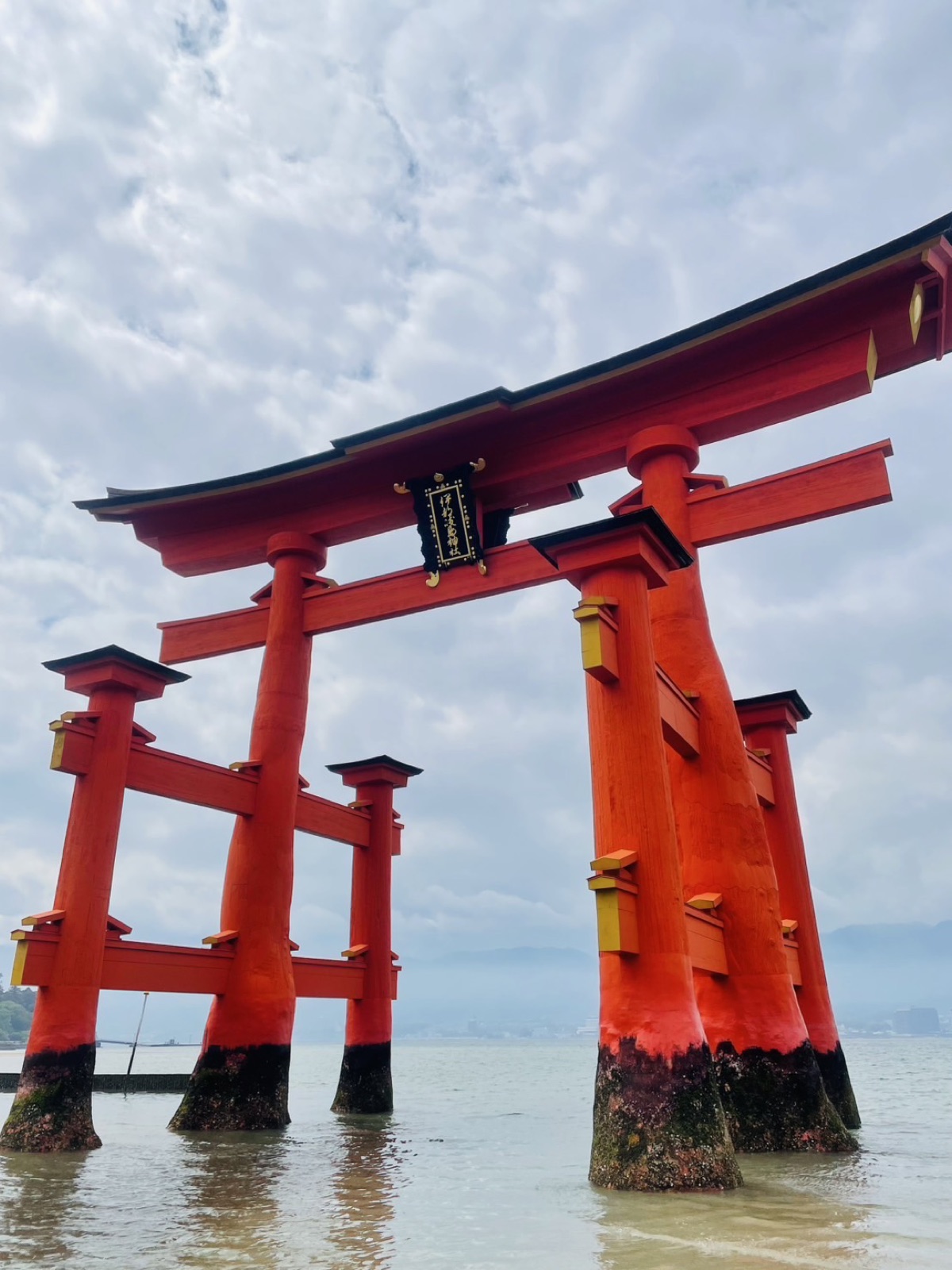
The famous gate sits a short distance from the shrine, in open water. At high tide, it looks suspended, the classic postcard image. At low tide, the water recedes and you can walk right up to the base. Standing under the weathered red columns gives you a sense of scale that no photo manages.
Tide tables are easy to look up online before you go. If you can, time your visit to catch one and stay for the other. The transition takes a few hours and gives you a natural reason to stop for lunch on the island in between.
How to get to Itsukushima from Hiroshima
From Hiroshima Station, take the JR Sanyo Line west to Miyajimaguchi. The ferry pier is a short walk from the station, the crossing to the island takes about ten minutes, and the shrine is roughly a fifteen-minute walk along the waterfront after you land. The deer find you well before you find the shrine.
If you’re traveling on a JR Pass, both the train leg and the JR-operated ferry are covered. For a fuller breakdown of routes and ferry choices, my Miyajima travel guide and the more specific how to get to Miyajima from Hiroshima post both go deeper than I’ll repeat here.
What else to do once you’re on the island
Most visitors come for the shrine and leave the same day, which is fine — there’s a lot to see in a few hours. If you have more time, the obvious add-ons are Mount Misen and Daisho-in Temple. Mount Misen is the sacred peak rising behind the shrine, with a ropeway most of the way up and a hiking trail to the summit. Daisho-in is a Buddhist temple complex tucked into the hillside, quieter than the main shrine and full of small statues that reward slow walking.
On whether the ropeway is worth the time, I’ve written about the Miyajima ropeway in detail elsewhere. The short answer is yes, on a clear day.
The other thing nobody tells you: the deer are everywhere, and they are not shy. They will check your map and your shopping bag. Don’t carry food in your hand.
Doing it in a day, or staying overnight
A lot of travelers ask whether Hiroshima and Miyajima are doable in a single day. They are, with some planning, and I’ve laid out a day-trip version here. If you can stay one night on the island, though, you’ll see the shrine after the day-trippers leave, which is a different experience entirely. The lights come on at sunset and the torii stays lit into the evening, with almost no one else around.
A quieter way to see Japan
Itineraries that try to cover Tokyo, Kyoto, Osaka, and Hiroshima in ten days end up being mostly Shinkansen. If you’ve already decided to come to Hiroshima, build in time for Miyajima. It’s the kind of place that justifies slowing a trip down rather than adding another city to it. For a broader sense of what else is worth your time in this part of Japan, my Hiroshima travel guide covers the city itself.
When friends visit from abroad, Itsukushima is always on the list, and it’s almost always the day they bring up first afterward.